
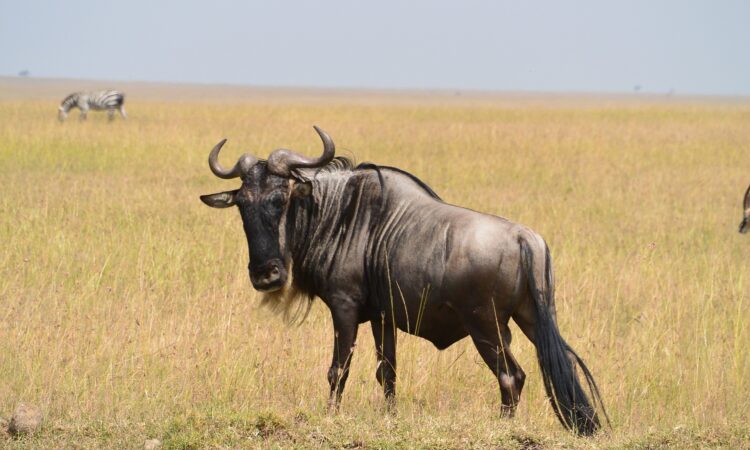
Wildebeests in Serengeti National Park are among the most important animals in the region and play a major role in the well known wildlife movement. They belong to the Bovidae family, which is the same family as cattle. Like cattle, wildebeests live in groups known as herds. Female wildebeests are usually brighter in color than males, and their backs are covered with long hair. The name wildebeest comes from Dutch words that mean wild beast, a term first used in southern Africa.
There are two main types of wildebeests found in East Africa. The eastern white bearded wildebeest lives around the Gregory Rift, while the western white bearded wildebeest is mainly found in the Serengeti Mara region. This makes Serengeti National Park one of the best places to see large numbers of wildebeests living freely in their natural environment.
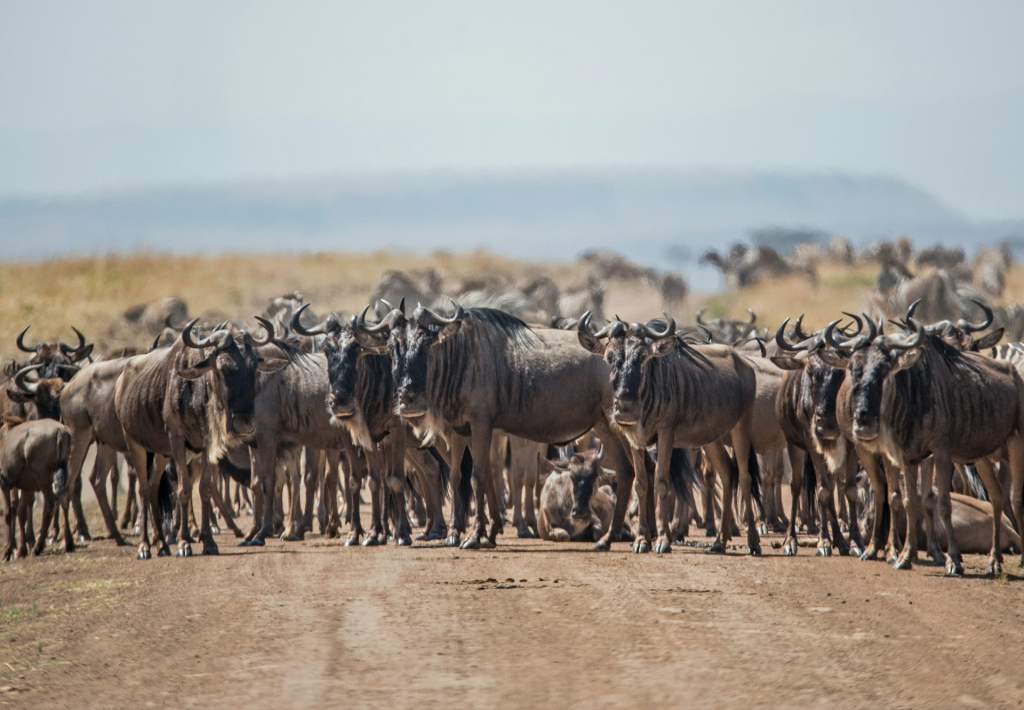
Wildebeests live in savanna and woodland areas within Serengeti National Park. They are very social animals and also strongly territorial. A single herd can have more than 100 members. Each herd usually controls an area of about two square kilometers. Living in large groups helps them protect each other and makes it easier to move across the land while feeding and resting.
During the dry season, usually from August to October, wildebeests move in search of water and greener grazing areas. This movement follows a natural pattern that repeats every year. Wildebeests communicate with each other using sounds and their sense of smell. Their calls are loud and can travel over two kilometers, which helps herd members stay connected even when spread out.
The gestation period of a wildebeest is about eight months and two weeks. Calving season happens between January and March. During this time, wildebeests spread across the southern plains of the Ngorongoro Conservation Area to give birth. These plains have short grass that is easy for young calves to eat. The open grassland also makes it harder for predators to hide. Zebras and gazelles follow the same routes during this season, so wildebeests move together with other animals as part of the wider wildlife movement.




